Showing posts with label Uttar Pradesh. Show all posts

Friday, 3 February 2012

How to Reach Varanasi

Air
The new Lal Bahadur Shastri International Airport, Babatpur, commonly known as Varanasi Airport is located about 22 km from the city centre and is well connected to ChennaiDelhiMumbai, KolkataKhajuraho, Bangkok, Bangalore, Colombo and Kathmandu.


Rail
The first railway line to Banares was opened from Kolkata in December 1862 and was built by the East Indian Railway Company. 

The double-decked Malviya Bridge takes both the railway and the Grand Trunk Road across the river Ganges near Rajghat. 

Varanasi Junction under the control of Northern Railways and Mughal Sarai Junction of East Central Railway are the two major railway stations within the city limit. Apart from these there are 16 other railway stations located within the city limits. 

Road
Previously, the city was connected by a single road from Taxila going through Pataliputra during the Maurya Empire. This road was later renovated and extended by Sher Shah Suri during the 16th century and later came to be known as the famous Grand Trunk Road. 

The NH 2 linking Delhi-Kolkata passes through the city and NH 7 which is the longest National Highway in India connects Varanasi with the cities of Jabalpur, Nagpur, Hyderabad, Bangalore, Salem, Madurai and Kanyakumari............

http://famousindiantouristplaces.blogspot.com

Wednesday, 25 January 2012

How to Reach Kanpur

Air
Kanpur is connected to major Indian cities and tourist spots through air service. The nearest airport is Chakeri that is just off to the town. There are daily domestic flights to and from Kanpur to several cities in India. Apart from the state owned Indian Airlines, there are many private air taxi operators that offer their services from Kanpur to other Indian cities. 

Rail
Since Kanpur lies in the heartland of the North Indian plains, it is well connected to Delhi, Kolkata, Mumbai and other parts of India. Kanpur Barrack is the main Railway station in Kanpur that falls on the Grand Chord route. Various Expresses and Super Fast trains connect Kanpur to the rest of India. 

Road
Situated in the flat Ganga plains, Kanpur has a good network of roads. Numerous public and private buses ply to and from nearby and far-flung cities. Uttar Pradesh State Road Transport Corporation runs a fleet of well-maintained buses apart from the luxury coaches offered by private operators............
http://famousindiantouristplaces.blogspot.com

How to Reach Meerut

Air
Meerut is situated very close to New Delhi, the seat of Indian Government. Delhi Airport is 60 odd Kilometers from Meerut. Delhi is in turn well connected to rest of India and world through a range of flights operated by various private and public carriers. From Delhi, one can hire a cab and reach Meerut in an hour and half via National Highways 24 and then NH 58. 

Rail
The nearest railway station is Meerut Cantonment Station that falls on the busy Delhi-Dehradun line of North Central Railways. Several Passenger as well as super fast trains connect Meerut to other popular towns and cities in Uttar Pradesh and rest of India. It has direct connectivity to cities like Delhi, Ghaziabad, Agra, Jaipur and Lucknow

Road 
Meerut is well connected to the cities like Mathura, Delhi, Chandigarh, Kanpur, Lucknow, Varanasi, Jhansi and Agra etc. Uttar Pradesh State Road Transport Corporation plies several buses to these cities. Various privately run luxury buses are also available............
http://famousindiantouristplaces.blogspot.com

Monday, 23 January 2012

Lucknow Excursions

Dudhwa National Park is stretched in an area across 810 square kilometers. The core area of the park itself is spanned around 650 square Kilometers. Although Dudhwa National Park has a range of animal as well as avian population, the park is famous as a perfect habitat for Swamp deer and Tigers. Dudhwa National Park was declared a national park in the year 1958. In the due course, keeping in mind its importance, it was first converted to a wildlife sanctuary in the year 1977 and was later declared a Project Tiger reserve in the year 1988. 

Dewa Sharif is a pilgrimage town that is situated just 40 odd Kilometers from Lucknow and 12 kilometers from the district headquarter of Barabanki. This pilgrimage site has a special place in the history of Awadh because of its efforts towards secularism in an otherwise communally volatile province. The place is renowned as the birthplace of Hajji Waris Ali Shah who was to influence the lives of many generations of people with his message of universal love for humanity. 

Nawabganj Bird Sanctuary is not only the best available Bird Sanctuary in Uttar Pradesh but also one of the most prominent in whole of India. Nawabganj Bird Sanctuary is a great excursion destination around Lucknow. Although Nawabganj Sanctuary is a small bird Sanctuary that is spread across 4 square kilometers, it attracts lots of migratory birds during winters. The sanctuary is precisely confined to an area that encloses the lake. This is a natural lake and has a very beautiful environ around it thus it attracts a lot of avian population 

It is said that Naimisaranya was the place where Bhagavatam was spoken. It is also said that a pilgrimage to Badrinath and Kedarnath is incomplete without a visit to Naimisaranya. In the Mahabharata it is said, "Anyone who fasts, prays, and attains perfection at Naimisaranya finds happiness in all the worlds."...........
http://famousindiantouristplaces.blogspot.com

Naimisharanya


Naimisharanya was the place where Bhagavatam was spoken. It is also said that a pilgrimage to Badrinath and Kedarnath is incomplete without a visit to Naimisharanya. In the Mahabharata it is said, "Anyone who fasts, prays, and attains perfection at Naimisharanya finds happiness in all the worlds." 

Lord Balarama, Dadhici Muni, the Pandavas, Prabhu Nityananda, and Ramanujacharya all came here. The Pandavas are said to have come here when they were in exile. This is the place where the demigods came to ask Dadhici for his body, to be able to create a weapon that would be able to kill the demon Vritrasura. Lord Rama is said to have performed a sacrifice here for killing Ravana.

It is said that if you bathe in Chakra-tirtha Kund and make an offering to the presiding deity, Lalita, on a full moon day that falls on a Monday, you will wash away all the sins committed in a lifetime............
http://famousindiantouristplaces.blogspot.com

Nawabganj Bird Sanctuary


Nawabganj Bird Sanctuary is not only the best available Bird Sanctuary in Uttar Pradesh but also one of the most prominent in whole of India. Nawabganj Bird Sanctuary is a great excursion destination around Lucknow. Although Nawabganj Sanctuary is a small bird Sanctuary that is spread across 4 square kilometers, it attracts lots of migratory birds during winters. The sanctuary is precisely confined to an area that encloses the lake. This is a natural lake and has a very beautiful environ around it thus it attracts a lot of avian population. Keeping in view its importance, the government of Uttar Pradesh declared this as a Bird Sanctuary and a protected area in the year 1984. 

The picturesque sanctuary is an ideal for photographers and picnic lovers. To enhance the knowledge of visitors, an information center has been established in the sanctuary itself. The place is not that great and is ill kept nevertheless it has the provision of screening film shows related to wildlife. Apart from that, the sanctuary boasts off a motel, a restaurant and small eateries that make it an interesting weekend trip. 

The avian population here comprises a mix of residents as well as migratory birds. The birds migrate across Himalayas from Tibet, Europe and Siberia during winters. Some of these birds fly over 5000 kilometers. Some of the major migratory birds during the season are Graylag Goose, Pintail, Red-Crested Pochard, Shoveller, Coot and Mallard. Some major local migratory and residential birds are Saras crane, Painted Stork, Peacock, White Ibis, Dabchick, Whistling teal, Open billed stork, Pheasant tailed jacana, Bronze winged Jacana, Purple moorhen, Lapwing, Tern vulture, Pigeon, King crow, Indian roller and Bee eater. The major reptiles found in the sanctuary are Cobra, Viper, Krait, Rat snake and Water snakes............
http://famousindiantouristplaces.blogspot.com

Dewa Sharif


Dewa Sharif is a pilgrimage town that is situated just 40 odd Kilometers from Lucknow and 12 kilometers from the district headquarter of Barabanki. This pilgrimage site has a special place in the history of Awadh because of its efforts towards secularism in an otherwise communally volatile province. The place is renowned as the birthplace of Hajji Waris Ali Shah who was to influence the lives of many generations of people with his message of universal love for humanity. 

Hajji Waris Ali Shah came of a family of Hussein Syed and was born in the first quarter of the 19th century. His father Syed Qurban Ali Shah died in his early childhood. It is heart-warming to know that both Hindus as well as Muslims held him in high esteem and regard him as a perfect Sufi and a follower of Vedanta. Khwaza Waris Shah left for his heavenly abode on 7th April 1905. He was buried at the spot where he died. Later a splendid monument erected in his memory by some of his devoted followers, both Hindus and Muslims, to mark the place. Every year Urs is held at the sacred tomb in the month of October-November.

A big fair known by the name 'Dewa Mela ' is held to commemorate the Saints. Pilgrims from all over Uttar Pradesh and India come to pay their homage to the great Sufi Saints, Hajji Waris Ali Shah and his father Qurban Ali Shah............
http://famousindiantouristplaces.blogspot.com

Dudhwa National Park


Dudhwa National Park is stretched in an area across 810 square kilometers. The core area of the park itself is spanned around 650 square Kilometers. Although Dudhwa National Park has a range of animal as well as avian population, the park is famous as a perfect habitat for Swamp deer and Tigers. Dudhwa National Park was declared a national park in the year 1958. In the due course, keeping in mind its importance, it was first converted to a wildlife sanctuary in the year 1977 and was later declared a Project Tiger reserve in the year 1988. 


The park shares its northern stretch with Nepal whereas its southern border stretches alongside River Suheli. The park is a brainchild of 'Billy' Arjan Singh, one of India's leading wildlife conservationists, who was instrumental in the creation of Dudhwa as a sanctuary of the Swamp Deer. Later he successfully hand-reared and introduced zoo-born Tigers and Leopards into the wilds of Dudhwa. 

As said above, the Major attractions of Dudhwa National Park are the Swamp Deer and Tigers. There are as many as 1500 deer and 100 tigers in the park when the last census was done. The park also boasts off a considerable number of the One-horned Rhino. Other major wildlife attractions are Elephants, Sloth bear, Jackal, Wild pig, Fishing cat, Leopard, Jungle cat and Civet apart from 40 odd species of mammals. Dudhwa also boasts off quite a good range of migratory birds that settle here during winters. It includes among others, painted storks, black and white necked storks, Saras-Cranes, woodpeckers, barbets, kingfishers, minivans, bee-eaters, bulbuls and varied night birds of prey, ranging from the great Indian horned owl to the jungle owlet

The park has a facility of Jeep safari that is primarily arranged on a 4X4 Customized Jeeps. A guide as well as a forest officer carrying tranquilizing gun will accompany you. Alternatively visitors can also opt for an Elephant safari............
http://famousindiantouristplaces.blogspot.com

Sunday, 8 January 2012

Agra, Uttar Pradesh


Agra is a city on the banks of the river Yamuna in the northern state of Uttar Pradesh, India. It is located at the banks of river Yamuna, 363 kilometres (226 mi) west of state capital, Lucknow and 200 kilometres (124 mi) south from national capital New Delhi. With a population of 1,686,976 (2010 est.), it is one of the most populous cities in Uttar Pradesh and the 19th most populous in India. Because 80 percent of the city's sewage flows into Yamuna River, it is 20th most polluted city in India. Agra can also refer to the administrative district that has its headquarters in Agra city.


The city finds mention in the epic Mahabharata where it was called Agrevaṇa, or 'the border of the forest'. Legend ascribes the founding of the city to Raja Badal Singh (around 1475), whose fort, Badalgarh, stood on or near the site of the present Fort. However, the 11th century Persian poet Mas'ud Sa'd Salman writes of a desperate assault on the fortress of Agra, then held by the Shahi King Jayapala, by Sultan Mahmud of Ghazni. Sultan Sikandar Lodi was the first to move his capital from Delhi to Agra in the year 1506; he died in 1517 and his son Ibrahim Lodi remained in power there for nine more years, finally being defeated at the Battle of Panipat in 1526. It achieved fame as the capital of the Mughal emperors from 1526 to 1658 and remains a major tourist destination because of its many splendid Mughal-era buildings, most notably the Taj Mahal, Agra Fort and Fatehpur Sikri Fort, all three of which are UNESCO World Heritage Sites.


Places to See:

Taj Mahal


Agra's Taj Mahal is one of the most famous buildings in the world, the mausoleum of Shah Jahan's favorite wife, Mumtaz Mahal. It is one of the New Seven Wonders of the world, and one of three World Heritage Sites in Agra.


Completed in 1653, the Taj Mahal was built by the Mughal king Shah Jahan as the final resting place for his beloved wife, Mumtaz Mahal. Finished in marble, it is perhaps India's most fascinating and beautiful monument. This perfectly symmetrical monument took 22 years (1630–1652) of labour and 20,000 workers, masons and jewellers to build and is set amidst landscaped gardens. Built by the Persian architect, Ustad 'Isa, the Taj Mahal is on the bank of the Yamuna River. It can be observed from Agra Fort from where Emperor Shah Jahan gazed at it, for the last eight years of his life, a prisoner of his son Aurangzeb. It is an acknowledged masterpiece of symmetry. Verses of the Koran are inscribed on it and at the top of the gate are twenty-two small domes, signifying the number of years the monument took to build. 


The Taj Mahal was built on a marble platform that stands above a sandstone one. The most elegant dome of the Taj Mahal has a diameter of 60 feet (18 m), and rises to a height of 80 feet (24 m); directly under this dome is the tomb of Mumtaz Mahal. Shah Jahan's tomb was erected next to hers by his son Aurangzeb. The interiors are decorated by fine inlay work, incorporating semi-precious stones.

Agra Fort


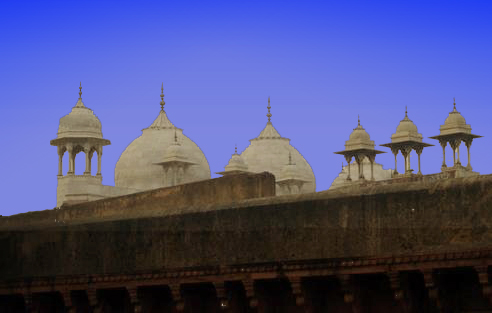
The great Mughal Emperor Akbar commissioned the construction of the Agra Fort in 1565 CE., although it was converted into a palace by his grandson Shah Jahan, being reworked extensively with marble and pietra dura inlay. Notable buildings in the fort include the Pearl Mosque or Motī Masjid, the Diwan-e-'am and Diwan-e-Khas (halls of public and private audience), Jahangir's Palace, Khas Mahal, Shish Mahal (mirrored palace), and the Musamman Burj. The forbidding exteriors of this fort conceal an inner paradise. The fort is crescent shaped, flattened on the east with a long, nearly straight wall facing the river. It has a total perimeter of 2.4 kilometres (1.5 mi), and is ringed by double castellated ramparts of red sandstone punctuated at regular intervals by bastions. A 9 metres (30 ft) wide and 10 metres (33 ft) deep moat surrounds the outer wall.Agra Fort (sometimes called the Red Fort), was commissioned by the great Mughal Emperor Akbar in 1565, and is another of Agra's World Heritage Sites. A stone tablet at the gate of the Fort states that it had been built before 1000 but was later renovated by Akbar. The red sandstone fort was converted into a palace during Shah Jahan's time, and reworked extensively with marble and pietra dura inlay. Notable buildings in the fort include the Pearl Mosque, the Diwan-e-'am and Diwan-e-Khas (halls of public and private audience), Jahangir's Palace, Khas Mahal, Shish Mahal (mirrored palace), and the Musamman Burj.

Chhatrapati Shivaji visited the Agra Fort, as a result of the conditions of the Treaty of Purandar entered into with Mirza Raja Jaisingh to meet Aurangzeb in the Diwan-i-Khas (Special Audience Chamber). In the audience he was deliberately placed behind men of lower rank. An insulted Shivaji stormed out of the imperial audience and was confined to Jai Sing's quarters on 12 May 1666. Fearing the dungeons and execution he escaped on 17 August 1666. A heroic equestrian statue of Shivaji has been erected outside the fort.

The fort is a typical example of Mughal architecture, effectively showing how the North Indian style of fort construction differentiated from that of the South. In the South, the majority forts were built on the seabed like the one at Bekal in Kerala.

I'timad-Ud-Daulah


The Empress Nur Jahan built I'timad-Ud-Daulah's Tomb, sometimes called the 'Baby Taj', for her father, Mirza Ghiyas Beg, the Chief Minister of the Emperor Jahangir. Located on the left bank of the Yamuna river, the mausoleum is set in a large cruciform garden criss-crossed by water courses and walkways. The mausoleum itself covers about 23 square metres (250 sq ft), and is built on a base about fifty meters square and about one meter high. On each corner are hexagonal towers, about thirteen meters tall. Small in comparison to many other Mughal-era tombs, it is sometimes described as a jewel box. Its garden layout and use of white marble, pietra dura, inlay designs and latticework presage many elements of the Taj Mahal.

The walls are white marble from Rajasthan encrusted with semi-precious stone decorations cornelian, jasper, lapis lazuli, onyx, and topaz in images of cypress trees and wine bottles, or more elaborate decorations like cut fruit or vases containing bouquets. Light penetrates to the interior through delicate jali screens of intricately carved white marble.

Many of Nur Jahan's relatives are interred in the mausoleum. The only asymmetrical element of the entire complex is that the tombs of her father and mother have been set side-by-side, a formation replicated in the Taj Mahal.

Akbar's Tomb, Sikandra


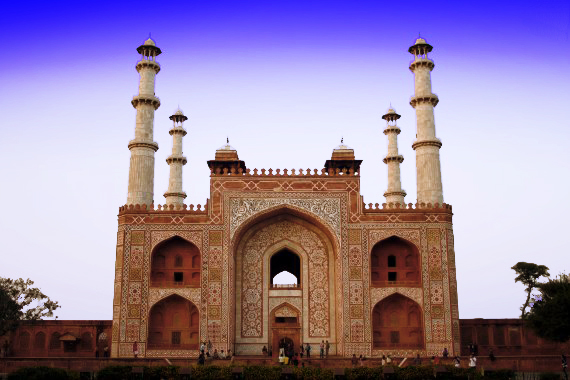
Sikandra, the last resting place of the Mughal Emperor Akbar the Great, is on the Delhi-Agra Highway, only 13 kilometres from the Agra Fort. Akbar's tomb reflects the completeness of his personality. The vast, beautifully carved, red-ochre sandstone tomb with deers, rabbits and langurs is set amidst a lush garden. Akbar himself planned his own tomb and selected a suitable site for it. To construct a tomb in one's lifetime was a Turkic custom which the Mughals followed religiously. Akbar's son Jahangir completed construction of this pyramidal tomb in 1613. The 99 names of Allah have been inscribed on the tomb.

Swami Bagh Samadhi


The Swami Bagh Samadhi is a monument to hold the ashes of Huzur Swamiji Maharaj (Shri Shiv Dayal Singh Seth) in the Swamibagh section, on the high road that goes from Bhagwan Talkies to Dayal Bagh, in the outskirts of the city. He was the founder of the Radhaswami Faith and the Samadhi is sacred to its followers. Construction began in February 1904 and still continues. Many believe that construction will never end at Swami Bagh – it is often seen as the next Taj Mahal. The carvings in stone, using a combination or coloured marble, are life-like and not seen anywhere else in India. The picture shown is taken from the rear of the building and shows only two floors. When completed, the Samadhi will have a carved dome and a gateway.

Mankameshwar Temple


The Mankameshwar Temple is one of four ancient temples dedicated to Lord Shiva located on the four corners of Agra City. It is located near the Jama Masjid and is about 2.5 kilometers from the Taj Mahal and less than 1 km from Agra Fort. Being located in the old city, the temple is surrounded by markets, many of which date back to the Mughal Era.

Guru ka Tal


Guru ka Tal was originally a reservoir meant to collect and conserve rainwater built in Agra, near Sikandra, during Jahangir's reign next to the Tomb of I'tibar Khan Khwajasara in 1610. In 1970s a gurdwara was erected here. Guru ka Tal is a holy place of worship for the Sikhs. Four of the ten Sikh Gurus are said to have paid it a visit. Enjoying both historical and religious importance, this gurdwara attracts a large number of devotees and tourists. Boasting elaborate stone carvings and 8 towers of the twelve original towers. It is located by national (Delhi-Agra) highway-2.

Jama Masjid


The Jama Masjid is a large mosque attributed to Shah Jahan's daughter, Princess Jahanara Begum, built in 1648, notable for its unusual dome and absence of minarets. The inscription at its entrance shows that it costed Rs 5 Lakhs at that time for its completion.

Chini ka Rauza

Notable for its Persian influenced dome of blue glazed tiles, the Chini ka Rauza is dedicated to the Prime Minister of Shāh Jahan, 'Allama Afzal Khal Mulla Shukrullah of Shiraz.

Ram Bagh


The oldest Mughal garden in India, the Ram Bagh was built by the Emperor Babar in 1528 on the bank of the Yamuna. It lies about 2.34 km north of the Taj Mahal. The pavilions in this garden are designed so that the wind from the Yamuna, combined with the greenery, keeps them cool even during the peak of summer. The original name of the gardens was Aram Bagh, or 'Garden of Relaxation', and this was where the Mughal emperor Babar used to spend his leisure time and where he eventually died. His body was kept here for sometime before sending it to Kabul.

Mehtab Bagh

The Mehtab Bagh, or 'Moonlight Garden', is on the opposite bank of the River Yamuna from the Taj Mahal.

Keetham Lake


Also known as Sur Sarovar, Keetham Lake is situated about 7 kilometres from akbar tomb Agra, within the Surdas Reserved Forest. The lake has an impressive variety of aquatic life and water birds.

The Cathedral of the Immaculate Conception


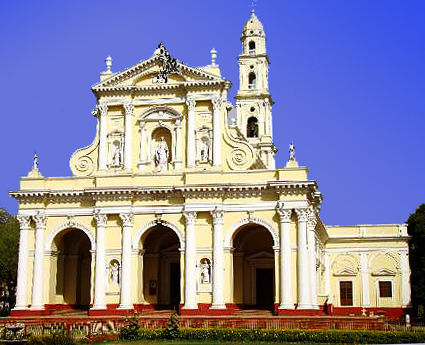
The Cathedral of the Immaculate Conception is the seat of the Roman Catholic Archdiocese of Agra.

Excursions ...........
http://famousindiantouristplaces.blogspot.com

Agra Excursions

Sikandra
 
Akbar' s tomb at Sikandra is a magnificent example of blending of different styles of architecture. It marks a considerable departure from the earlier Mughal buildings. The tomb carries the characteristic flavor of the airy tiered pavilions of the Agra Fort and Fatehpur Sikri. The tomb of Akbar, though Islamic in spirit, is a blend of styles. The magnificent entrance, use of exquisite patterns, excellent Jaalis, fine Persian style calligraphy and the Char Bagh garden layout etc. are representative of Islamic influence. On the other hand, the absence of a dome and use of canopies reflect the local influence.

Bateshwar
 
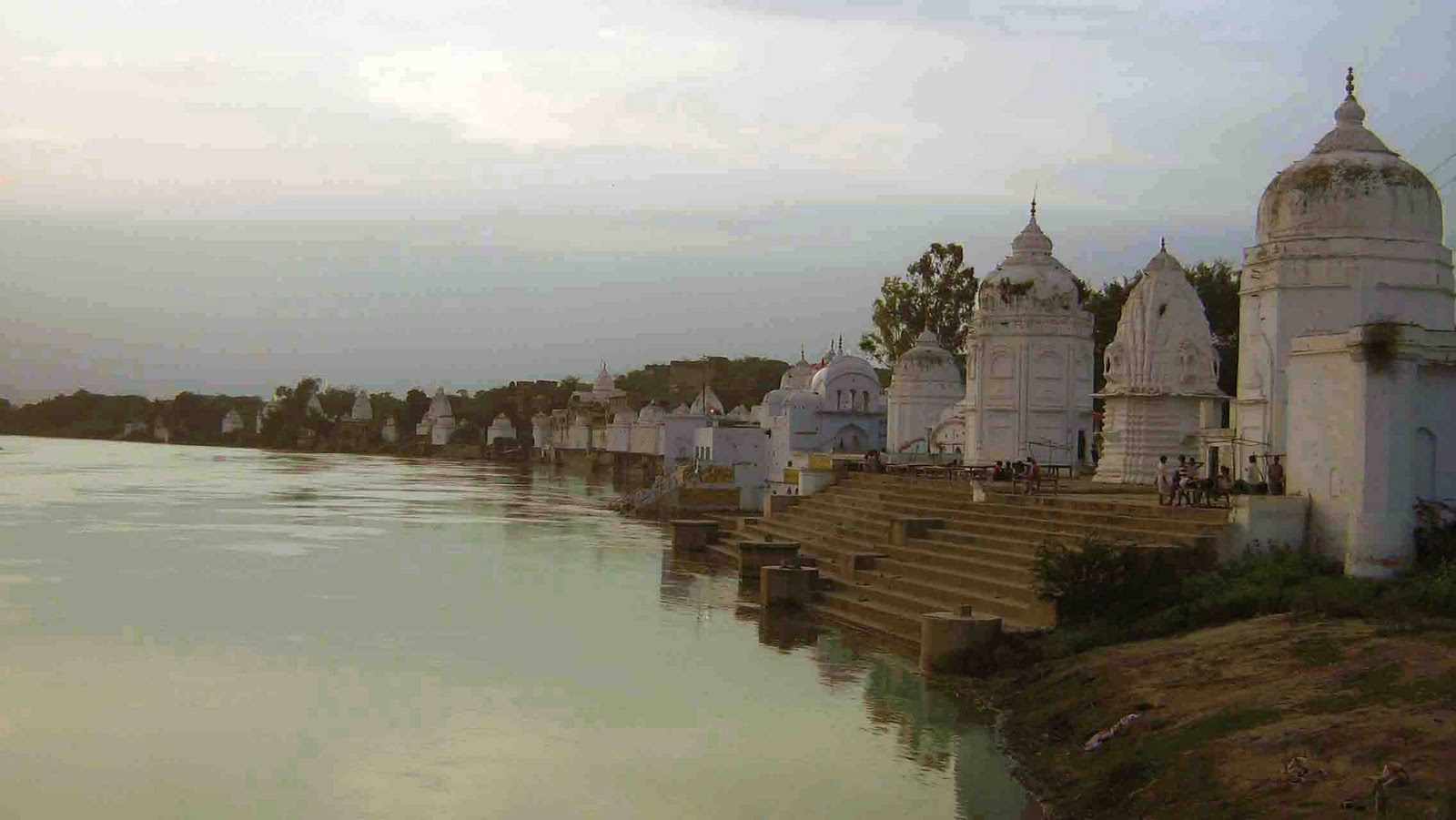
Bateshwar is a dusty town situated nearly 70 kilometers from downtown Agra. An otherwise sleepy town, Bateswar, an important spiritual and cultural center, comes to life in the month of November every year. It is when the annual cattle fair is held here. This enormous cattle fair is held at the banks of Yamuna in the 'Kartik' month of Hindu calendar. Nevertheless, the fair is not the only draw for the tourists. Apart from that there are as many as 108 temples of Shaivite sect at the banks of Yamuna.

Fatehpur Sikri
 
Fatehpur Sikri was the imperial city of the Mughal dynasty between 1571 and 1584. Fatehpur Sikri is actually a historical capital city made out of twin village of Fatehpur and Sikri that are situated 45 odd kilometers from the city of Agra. The city is situated amidst barren ridge. Emperor Akbar established this city, to serve jointly with Agra, as the imperial capital of Mogul empire. The story of this 4 centuries old city is no less interesting than the city itself.
...........
http://famousindiantouristplaces.blogspot.com

Fatehpur Sikri


Fatehpur Sikri is actually a historical capital city made out of twin village of Fatehpur and Sikri that are situated 45 odd kilometers from the city of Agra. The city is situated amidst barren ridge. Emperor Akbar established this city, to serve jointly with Agra, as the imperial capital of Mogul empire. The story of this 4 centuries old city is no less interesting than the city itself.

It has been reported through the chronicles of History that Emperor Akbar had no issues and that's why his laments new no bound. Somebody advised him to ask for an audience with the famous Sufi saint, Khwaza Salim Chisti who resided at Sikri village. He walked the distance with the royal entourage. Salim Chisti blessed him with a son who was named Salim in reverence to the saint. The same prince when sat on the throne, re-christened himself to Jahangir Jahandar. Akbar ordered to build the city of Sikri to commemorate the arrival of the prince.

The most interesting monument in the city is the mighty Buland Darwaza that guards the entrance of the Gate. As you enter the gate, Jama Masjid falls to your left. The beautifully carved tomb of Khwaza Salim Chisti is situated in the middle of the big square courtyard. As you take the right gate, Sikri fort falls on your left and so are Panch Mahal and Jodha Bai Palace. Architecture of all these buildings has a subtle blend of Hindu and Islamic architectural designs. Fatehpur Sikri has all these and much more.


Places to See:


Salim Chisti Tomb
...........
http://famousindiantouristplaces.blogspot.com

Buland Darwaza


Buland Darwaza is a 15-storied high gateway that guards the Northeastern entrance of the city of Fatehpur Sikri. Historians have come to a consensus that this building was constructed in the year 1575. It was commissioned by Emperor Akbar to commemorate his victory over Khandesh and Ahmednagar in Gujarat and Deccan respectively.

The intimidating structure stands 43 meters or 140 feet on the pedestal and a cool 54 feet above the ground. The gateway is approached by a steep flight of 42 steps, which add height and majesty to the entire structure. Buland Darwaza that is counted as one of the tallest gateways in the world is almost entirely made out of the red-sandstone with a generous dose of marble decoration on it. The blend of Hindu and Persian architecture is very evident by the use of Quranic inscription on the front and pillar and Cenotaph on the heights of the gateway. The calligraphy work done on the inner façade of Buland Darwaza has very less parallels in India.

Buland Darwaza has a very famous inscription written on it. This inscription is actually a quote attributed to Jesus Christ, who is revered equally by both Christians as well as Muslims. It says, "The World is but a bridge, pass over but build no houses on it." that is almost ironical for a city that was abandoned in less than 15 years from the day it was constructed.
...........
http://famousindiantouristplaces.blogspot.com

Fatehpur Sikri Fort


Fatehpur Sikri was commissioned by Emperor Akbar to act as his imperial capital along with the Red Fort of Agra. Fatehpur Sikri Fort was commissioned in the year 1570 and was completed in 5 years. While the Agra fort acted as a military base and garrison, Fatehpur Sikri fort was used for the residence purpose. Therefore it is but natural that the Sikri Fort has cluster of buildings that were used for different purposes as in case of Delhi and Agra's Red Forts. Following are some of the most important buildings of the Fatehpur Sikri Fort Complex.

Private Living Quarter
Private living quarters are situated at the southern end of courtyard. They are architecturally centered on the pool known as Anup Talab. It houses the famous library of Emperor, which was a seat for the philosophical and intellectual discourses. Close by is the Royal Archive called Daftarkhana. This was used to store all the official records of the empire. Above the Daftarkhana lies 'Khwabgah' or royal bedroom. Water channels were reportedly used to cool the whole space.

Miriam Palace
Miriam Palace is actually women's quarter also called Zanana or Harem in Hindustani. Miriam Palace lies east of the Male quarters. A small doorway joins the male quarter with the female one. The palace has been named after one Miriam of the then Goa who was one of the wives of Emperor Akbar. The interiors of the Miriam Palace were richly embellished with gold.

Jodhabai' s Palace
Jodhabai' s Palace is the largest of all the palaces in Fatehpur Sikri. This was named after Jodhabai, Akbar' s favorite wife and mother of his heir Salim. This palace was specially made to house his queens. The Architectural elements of Gujarat, Mandu and Gwalior have been blended with traditional Islamic designs to decorate this palace.

Diwan-e-Aam
Diwan-e-Aam is the first enclosure of the palace from the entrance. Divan-e-Aam is actually a vast courtyard that was used by Emperor Akbar for the daily public audience called 'Jharokha' in Hindustani. It was also used to dispense justice.

Diwan-e-Khas
Diwan-e-Aam gives access to the second enclosure that is called Divan-e-Khas. This is undoubtedly the finest building in the entire Fatehpur Sikri. The hall was used for the private audiences and other court activities. Divan-e-Khas is a magnificent chamber that is dominated by a massive carved pillar. It supports a capital that in turns support a balcony.
...........
http://famousindiantouristplaces.blogspot.com

Panch Mahal


Fatehpur Siri might have been abandoned in less than 15 years from the day it was constructed, it has left many heritages to ponder upon and appreciate. Most of these monuments are living examples of Indo-Islamic architectural blend in India. Panch Mahal is one of them. Panch Mahal is basically a five-storied structure that can easily pass as an architectural marvel. Panch Mahal also signifies the undiluted imprint that Buddhism has left on the Indian psyche. This is proved by the fact that Panch Mahal is built on the Buddhist architectural style.

Built on the pattern of a Buddhist Temple, Panch Mahal was basically a pleasure palace of emperor Akbar. He primarily used it for relaxation and entertainment purpose. The structure has been so designed that each story is pillared and is smaller than the other as you move upwards. While no less than 84 columns support the ground floor, the uppermost domed floor has only 4 columns. The whole structure is very airy and was styled to give respite from the scorching summers of Agra.

Panch Mahal stands close to the Zeenana quarters or Harem and that consolidates the fact that it acted as a pleasure palace. The pillars that originally had Jaalis between them support the whole structure. The women of the royal household and ladies of the harem originally used the pavilion and that is why Jaalis have been used. The pavilion gives a majestic view of the fort that lays on its left.
...........
http://famousindiantouristplaces.blogspot.com

Salim Chisti Tomb


Salim Chisti is synonymous with Sikri. Khwaza Salim Chisti was a Sufi saint of the Chisti order in 16th century India. The saint used to reside in the then dusty village of Sikri. It is said that Khwaza Salim Chisti blessed emperor Akbar with a son. The son was named Salim in reverence of the saint, who in the course of history came to be known as Emperor Jahangir Jahandar. Akbar later ordered the commissioning of the city of Fatehpur Sikri that had to be built out of the twin villages of Fatehpur and Sikri.

When Khwaza Salim Chisti died, he was buried in the same Sikri complex where he once resided. A tomb that is popularly called Mazaar in Hindustani was later commissioned that stands in the middle of the courtyard of the Jama Mosque in Sikri Fort Complex. The structure falls slightly right from the line of view when one enters from the Buland Darwaza. If you take a bird eye view of this structure, it looks like a marble Jewel-box. Actually, the tomb was built originally with Red-sandstone but was later converted in to a marble one. The exterior is separated from the sanctum with the help of Jaalis. The Naqqashi and Jaali work of this low-domed tomb has fewer parallels in India.

Inside, the structure is heavily ornamented with Pearls, Lapis Lazuli and Topaz. A green cloth covers the tombstone, typical of the Sufi order. The tombstone rests under a canopy beautifully carved out of ebony and decorated with pearl and brass. A corridor for circumambulation surrounds the square tomb chamber. The place sees hordes of visitors every day and is popular as a wish-fulfilling site among the barren women.
...........
http://famousindiantouristplaces.blogspot.com

How to Reach Agra

Air
Agra being the hottest tourist destination in India is well connected to cities like Delhi, Khajuraho, Varanasi, Mumbai and Bangalore etc. Kheria airport is 6 km from Agra town. Nearly all the major Public as well as private carriers offers their service to and from the city of Agra.

Rail
Agra is well connected to the major cities of India. Agra Cantonment Railway Station is the main Railway station in the city. Regular expresses as well as super-fast trains are available to destinations like Delhi, Varanasi, Jaipur, Lucknow, Mumbai and Kolkata. Book the tickets in advance to avoid rush.

Road
Agra is well connected to the cities like Mathura, Delhi, Chandigarh, Kanpur, Lucknow, Varanasi, Jhansi, Chitrakoot, etc. Uttar Pradesh State Road Transport Corporation plies several buses to these cities. Various privately run luxury buses are also available.
...........
http://famousindiantouristplaces.blogspot.com
Backlinks to my website?